More than just a midway point on air travels, Dubai is a city that is at an intersection between the past and the future, the west and the east. The juxtaposition of the traditional quarter and souqs('market') as well preserved relics from the past in a desert and the green patches and glittering buildings all around belies the harsh reality of the desert, bearing testimony to the supremacy of human will.
 |
| Dubai Creek in the old quarters of the city |
 |
| Dubai Marina |
Making the Right Choice of Activities
Dubai is a tourist hot spot offering endless recreational choices and a number of ways of exploring them. The choices one makes influences more than just the cost of holiday. There are too many tourist activities centered around animal based entertainment here - from Dolphinarium, Aquariums on gigantic scale to snowy ski-able landscape complete with Penguins! The implication of a traveller's choice would be far-reaching - patronising such places would have more non-desert species shipped in, in an endless cycle of more footfalls - more displaced animals subjected to a life of servitude.
Dubai is a tourist hot spot offering endless recreational choices and a number of ways of exploring them. The choices one makes influences more than just the cost of holiday. There are too many tourist activities centered around animal based entertainment here - from Dolphinarium, Aquariums on gigantic scale to snowy ski-able landscape complete with Penguins! The implication of a traveller's choice would be far-reaching - patronising such places would have more non-desert species shipped in, in an endless cycle of more footfalls - more displaced animals subjected to a life of servitude.
The Ground Reality
Dubai is a city built in a desert with a substantial immigrant population and thus every plan has to factor these two facts. The most suitable months to visit the city would be the non-summer months from October to March. There are far too many tourist traps in the city for the uninitiated and unaware - from being waylaid right in the airport with weird investment schemes by salespeople who wouldn't take 'No' for an answer, over-enthusiastic salesmen at the souqs to the array of rates charged for desert safaris.
Visa
Visa for entering the country can be applied online on https://www.gdrfa.ae/GCCIND/gccLogin.do?userAction=switchToEnglish. Once the online application is filled and fees paid, the processing is very quick. Even GCC residents have to apply for and hold an e-visa prior to visiting the country.
Commuting within the city
The city's public transportation is well organised with 2 metro lines, a tram line, a monorail line, well connected bus routes and ferry boat routes. It's perfectly possible to use this wide network of public transportation to tour the city at a fraction of a cost of a hired car or a hop-on-hop-off tour for that matter and that too in perfect comfort.

 Burj Khalifa


The most popular attraction in Dubai is perhaps riding up the elevator to floor 124/125 in Burj Khalifa. This 2,700 feet high building completed in 2010 is the tallest building in the world(will remain so for at least a year more). At 1,483 feet, the observation deck on 124th floor is higher than Eiffel tower. The view from that height is a little more detailed than from an aircraft but nevertheless it's a worthy experience especially riding up the elevator which ascends at a rate of 10 metres per second. The only proof of ascent is the ears adjusting to the change in pressure corroborating the reading on the lift's display panel. It would have been brilliant had the lift's walls been made of glass and we could follow the ascent like in the Eiffel tower but as the lifts are in the centre of the building it would have required a design change for that to have been possible and I am sure it was considered and shelved.
The ticket can be booked online and especially for the peak season/peak hours of evening it's best booked in advance on http://www.burjkhalifa.ae/en/index.aspx. My pick of time is 5:30AM which affords a view of a night-lit Dubai, weather conditions permitting, a beautiful sun-rise and a city view in the daylight with minimal crowd.
Ticket to 124th floor costs AED 125/AED 200(for 3:30PM to 6PM slots) and to 148th floor costs AED 350(from 6PM to closing hours) /AED 500 (from opening to 6PM).
Bur and Deira area
The ticket can be booked online and especially for the peak season/peak hours of evening it's best booked in advance on http://www.burjkhalifa.ae/en/index.aspx. My pick of time is 5:30AM which affords a view of a night-lit Dubai, weather conditions permitting, a beautiful sun-rise and a city view in the daylight with minimal crowd.
Ticket to 124th floor costs AED 125/AED 200(for 3:30PM to 6PM slots) and to 148th floor costs AED 350(from 6PM to closing hours) /AED 500 (from opening to 6PM).
 |
| Pre-sunrise Dubai from Burj Khalifa observation deck |
 |
| View from Observation deck of Burj Khalifa as a new day dawns on Dubai |
 |
| Sun rise from Burj Khalifa, Dubai |
The area on either side of the creek is where Dubai has its roots of first habitation and occupation of fishing and pearl diving long before oil was discovered. This is the cultural hub of the city and a lot of buildings and markets from the past have been preserved and/or redone to reflect the past.
This area can be explored comfortably in a day.
- Start in the morning with a sumptuous breakfast in MTR(close to the Al Fahidi metro station on the green line). There are many other vegetarian restaurants in this area(and in Dubai, for that matter) where one can stop for a hearty lunch or a snack any time of the day.
- Visit the Heritage house(a traditional Arabic mansion) (Sat-Thur 8AM - 8:30PM, Fri 2:30PM - 7:30PM, Free admission)
- Walk through the Bastakiya quarter of wind-towered traditional houses and narrow lanes
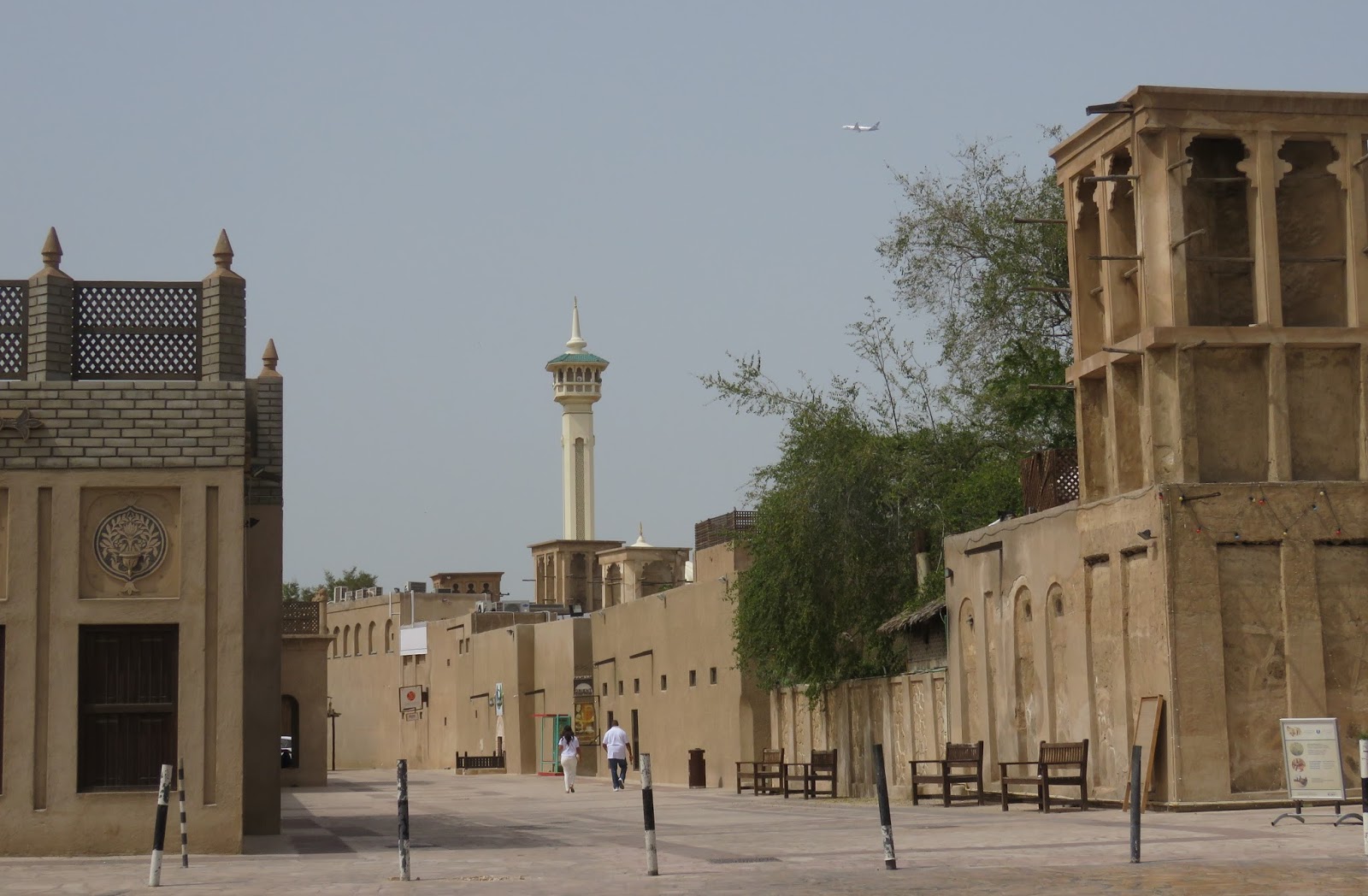 |
| Bastakiya quarter, Dubai |
- Proceed to the 1787 built Al Fahidi Fort which was the ruler's residence and today houses the Dubai Museum (Sat-Thu 8:30AM - 8:30PM, Fri: 2:30PM - 8:30PM, Admission fees: AED 3)
 |
| Al Fahidi Fort, Dubai |
- Walk past the beautiful Grand Mosque just behind the Dubai Museum (it is not open to non-Muslims.)
- Take the walkway immediately to the west of the mosque, walk through the Textile Souq to reach the 'Hindi Lane' populated by Indians. The Shiva temple, the Gurudwara, shops selling articles of worship with Holy Basil plants for sale at the shop entrance inviting the buyers in, transports one to traditional quarters of India. Meander through the narrow lanes and glimpses of the creek through narrow walkways will beckon you back to Dubai.
- Keep the creek to your right and walk westwards through the traditional looking Bur Dubai Souq and Old Souq selling cloths, spices, beautiful stained glass lamps and an array of nick-knacks for the enthusiastic shopper.
 |
| Bur Dubai Souq, Dubai |
 |
| A spice store at Bur Dubai Souq, Dubai |
- Take an abra (a traditional wooden boat smaller than Dhow) from any boat station on the way to cross the creek from the Bur side to Deira side to visit the Spice Souq and Gold Souq.
- Take a boat back to the Bur side to Al Ghubaiba station(the last station on the Bur side) to visit Sheikh Saeed Al Maktoum's house, the house of the king of Dubai from 1912 to 1958. Beside the beautiful house itself, there are many beautiful photographs showcasing the growth of the city from its humble beginnings. (Time: Sat-Thu: 8AM - 8:30PM and from 3PM - 10PM on Fridays, Entrance fees: AED 3)
 |
| Sheikh Saeed Al Maktoum's house, Dubai |
 |
| Inside the Sheikh Saeed Al Maktoum's house, Dubai |
- Also visit Sheikha Sana Bint Mana Al Maktoum's house (just beside the Al Ghubaiba marine station). She was the daughter of the then education minister who educated his daughter in the 1930s, she went on to marry the ruler's brother and made a name as a businesswoman whose opinions carried influence in the court of the ruler. (Free admission)
 |
| Sheikha Sana Bint Mana Al Maktoum's house, Dubai |
- At 6:30PM a ferry ship leaves from Al Ghubaiba station to Dubai Marina on a one hour journey which is a convenient way to see the cityscape from the waters. Weather conditions permitting a lovely sun set as well. The journey costs AED 50 per person and tickets have to be bought at the RTA (Road Transport Authority) counter at the station (no online or prior bookings).
- Get off the boat at Dubai Marina station, walk down the popular 'Marina' next to the 'inland' waters with the glittering skyscrapers just beyond the waters. Dine at one of the many restaurants or walk to the Jumeirah Lakes Towers Metro/tram station to take a train back to your destination.
 |
| Night-lit skyline of Dubai |
- Time permitting also visit Sheikh Mohammed Centre for cultural understanding near Heritage Centre and Heritage and Diving village near Sheikh Saeed Al Maktoum's house (this was closed in April 2017 due to repairs on the approach road).
My honest opinion - this is the most overrated activity in Dubai. Depending on how much money one shells out, comfort of the peripheral services would be better, I presume, but sadly the dunes themselves have almost been flattened by the hoards of tourists who throng the desert through the many agencies. The cultural activities are nice enough but sitting with a hoard of men ogling at a performer is not my idea of enjoying a cultural show, and if use of animals for rides and Falcon for photos doesn't put one off, the food served in endless non-biodegradable material should. Unfortunately it doesn't.
Miracle Garden
Miracle garden sounds like a beautiful place with pretty floral plant arrangements, it's open in the non-summer months and every year new attractions seem to be added. In 2016-17, the entry fees was AED 40 per person. It's open from 9AM to 9PM on weekdays and till 11PM on Fridays, Saturdays and holidays. The closest metro is Mall of the Emirates or Saraf DG stations and a taxi ride from there costs around AED 30. Late afternoon and early evenings would be a nice time to visit this place. Check out the website to see if the garden is open, especially at the start of winter and end of summer months - http://www.dubaimiraclegarden.com/#all/1/grid
Ras Al Khor
My favourite place in Dubai. At the head of the creek that flows through Dubai is a lagoon where Mangroves abound and Greater Flamigoes amongst many other species of birds make it their home especially in the winter months. The authorities have done their bit to make the stay as comfortable as possible. The entire lagoon has been fenced and cordoned off, the birds are fed twice a day at 9AM and 3:30PM as a supplement to the food that's available naturally. 2 bird-watching centres have been set up and I was very impressed by the design and the choice of material, both aimed at making the birds feel un-intruded upon. The 2 hides which are just about a KM apart are open to public for free from Sat-Thu from 9AM - 4PM. The closest metro station is Al-Jafiliya. Taxi drivers usually aren't aware of the place so use GPS to guide the driver. We hired a taxi from Al Jafiliya, got the taxi to wait for us at the 2 hides and then were dropped back at Al-Karama station almost an hour later and it cost us AED 90.
 |
| Greater Flamingoes in the Ras Al Khor Mangroves, Dubai |
 |
| Ras Al Khor lagoon, Dubai - Mangroves and its most famous residents of Greater Flamingoes |
 |
| One of the Bird watching cabins in Ras Al Khor Mangrove Lagoon, Dubai |
The musical fountains by the entrance of Dubai Mall is another one of those activities in Dubai that's free and beautiful. The fountains come to life every evening from 6PM to 11PM, every half hour for about 5 minutes each to a different tune every time. There are 2 shows in the afternoon as well at 1:30PM and 2 PM on Fridays and 1PM and 1:30PM on other days.
The Malls
 |
| Musical Fountain, Dubai Mall entrance, Dubai |
I am sure there are more malls in Dubai than species of birds in Ras Al Khor. Malls world over tend to be very homogeneous and I don't think spending holiday time in such a mall is a very clever thing to do, unless of course you are trying to escape the desert heat of the day in summers.
If you do like to visit a couple of malls to just to see how differently Dubai does it, Dubai Mall (the largest mall in the world - on your way to Burj Khalifa and Fountains) and European themed Mercato Mall are good options.
Jumeirah Coast
If you do like to visit a couple of malls to just to see how differently Dubai does it, Dubai Mall (the largest mall in the world - on your way to Burj Khalifa and Fountains) and European themed Mercato Mall are good options.
Jumeirah Coast
If you haven't yet tired of the sights of sparkly buildings, there's quite a bit more of it to see here. From the Atlantis hotel with its Aquaventure water park on Palm Jumeirah (with its controversial import of 28 bottleneck dolphins from Solomon islands), Mall of Madinat, European Renaissance inspired Mercato Mall, Burj Al Arab and more. There's also a stretch of sandy beach (Umm Suqeim Public Beach) and the Jumeirah Mosque that welcomes all.
Palm Jumeirah
Palm Jumeirah
I just had spare time and inclination to take the sights of Jumeirah stretch from a boat, but we did make time to ride the 5KM long monorail on the Palm. Palm Jumeirah, an artificial archipelago shaped like a palm leaf, complete with fronds is the smallest of 3 such planned islands. The Palm Jumeirah is the only one completed as yet and is populated by hotels, malls and residential villas. It costs AED 25 per person for a round trip ride on the monorail.
Places like The Palm make me wonder why we don't expend as much energy and effort to preserve and celebrate the natural as we do in creating something exotic. In fact cities like Dubai make me wonder if people would respect nature more if the flora sparkled and beautified their homes and cities and fauna danced around entertaining them.
 |
| Monorail line on Palm Jumeirah and the buildings in Dubai Internet City and Dubai Media City beyond |
 |
| View of one of the Palm Jumeirah beaches and buildings from the Monorail ride. |
 |
| Residential villas on Palm Jumeirah, Dubai |


